
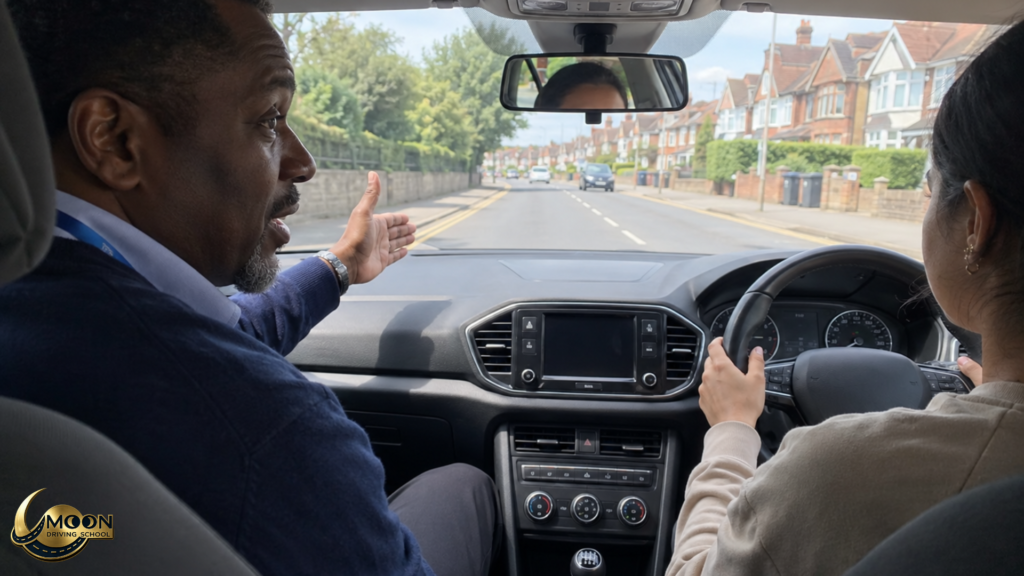
The DVSA publishes data on driving test results every year — and the same mistakes appear at the top of the failure list time and time again. Understanding what causes most people to fail is one of the most valuable things you can do before sitting your practical test.
1. Observations at Junctions
The single most frequent cause of driving test failures in the UK. This includes not checking properly before emerging from a junction, pulling out when it is not safe, failing to give way when required, and misjudging the speed or distance of approaching vehicles.
How to avoid it: Your instructor should specifically practise junction observations with you — approaching slowly enough to make proper assessments without stopping unnecessarily. At Moon Driving School we train on the real junctions used at Morden, Tolworth and Mitcham so you are not encountering them for the first time on test day.
2. Mirrors — Change of Direction or Speed
Failing to check mirrors when changing direction, changing speed or before manoeuvres is consistently in the top five causes of test failure. Many learners check mirrors — but not at the right moments or frequently enough for the examiner to be satisfied.
How to avoid it: Develop the habit of Mirrors-Signal-Manoeuvre (MSM) on every single road action, not just when you remember. Your instructor should reinforce this from the very first lesson.
3. Inappropriate Speed
This covers two opposite mistakes — driving too slowly below the speed limit where it is unnecessary, and exceeding the speed limit. Both can result in faults.
How to avoid it: You should be able to identify and adapt to speed limits quickly and confidently. Know the default speed limits — 30mph in built-up areas, 60mph on single carriageways, 70mph on dual carriageways and motorways — and check for signs frequently.
4. Lack of Steering Control
Steering too wide on corners, mounting the kerb, incorrect positioning when turning and poor slow-speed control all fall under this category.
How to avoid it: This is a foundational skill that your first lessons should focus on. If you are still uncertain about steering control as your test approaches, consider taking a mock driving test to identify any remaining issues before the real thing.
5. Move Away Safely
Pulling away from the kerb without proper observations — not checking mirrors, not checking blind spots — is one of the most common and most avoidable test failures.
How to avoid it: Every time you pull away, follow the same routine: mirrors, signal, blind spot check, then move when safe. Do it the same way every single time, in every lesson, not just when you remember.
6. Positioning — Lane Discipline and Road Position
Poor lane discipline, straddling lanes, cutting corners and positioning too close to the kerb or too far into the road are regular causes of faults.
How to avoid it: Road positioning should be addressed throughout your lessons, not just in the final weeks before your test. Your instructor should flag any positioning habits early and correct them before they become ingrained.
7. Responding to Traffic Lights
Missing the transition from green to amber, moving prematurely, or freezing when a light changes are all common issues under test pressure.
How to avoid it: Practise anticipating light changes — approach amber lights with a decision already being made, not a freeze response. Confidence comes from repeatedly driving the roads you will face on test day.
8. Reverse Parking
Bay parking and parallel parking cause significant anxiety for many learners — and that anxiety often leads to errors under test pressure.
How to avoid it: Practise manoeuvres until they feel routine rather than rehearsed. The examiner does not expect perfection — they expect control, observation and accuracy. A mock driving test is one of the best ways to experience manoeuvres under realistic conditions before the day that counts.
The Bottom Line
Most test failures come from errors that are entirely preventable with the right preparation. Training on the real test routes, taking a mock test before your practical, and having an honest conversation with your instructor about your weak spots are the three most effective things you can do.
Moon Driving School offers lessons across Morden, Wimbledon, Tooting, Earlsfield, Southfields and across South West London — all trained specifically on the routes used at the local test centres. Get in touch today and let us make sure you are properly prepared.